



The Trending Stuff About Trademark Registration Procedure.
 Print
PrintListen to this Article
The process for registration of the trademark can be carried out by the business owner or his/her representative. The registration process can be described in the following steps:
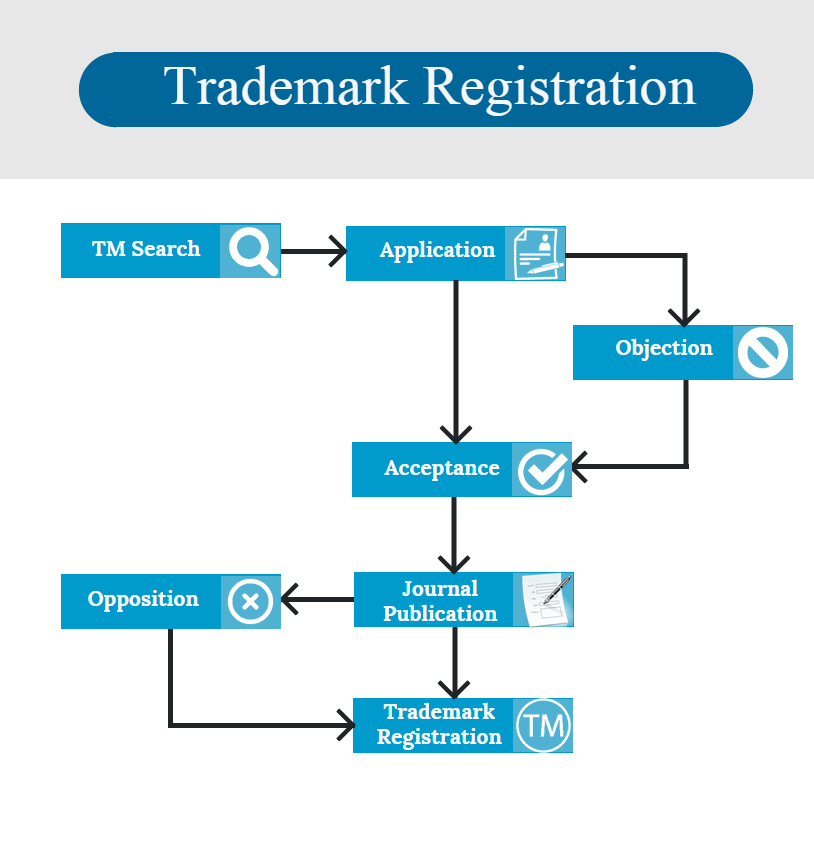
Trademark search:
A trademark search is a review of various information, including trademark databases, and occasionally commercial and marketplace resources, typically designed to determine whether a particular trademark is available for (a) use without risk of infringement of the rights of a prior user or registrant, and (b) registration, referring to the criteria for registrable trademarks under local laws.
It is highly recommended to conduct a trademark search before filing for a trademark registration application to ensure that there is not a prior existing mark similar to yours that could prevent your mark obtaining registration.
Trademark filing:
Once it is found out that the proposed trademark does not conflict with any other trademarks available at the Registry, a trademark application is filed at the Trademark Office. Now the Trademark application can be filed for more than one class of goods in one application. An application with priority rights shall be filed within 6 months from the date of initial grant of the registration application of the mark in other country.
Examination:
After filing, Trade Marks Registry will then examine the mark to ensure it meets the requirements for registrability in India. Examination currently occurs around 8-10 months after filing the application, however it is possible to request an expedited examination by paying extra government fees.
Publication:
If the Registrar objects or wants fulfillment of certain conditions, a Response is sought from the Applicant. After the filing of the Response, if the same is accepted, the Trademark proceeds for publication in the Trademark Journal. If the Response is not accepted, a hearing can be requested. At the hearing, the Registrar may allow for the registration or reject it absolutely. If the Registrar allows, the Trademark proceeds for publication in the Trademark Journal.
Opposition:
When the Trademark is advertised in the Trademark Journal, then third party can oppose the registration of the Trademark within the 3 months from the date of the Trademark journal made available to the public. Normally the following person opposes the registration of Trademark.
- The owner of an earlier Trademark application or registration covering a similar Trademark for similar goods
- A person who has used the same or a similar Trademark prior to the client, but who has not sought registration of the Trademark.
If there are no oppositions within 4 months from the date of advertisement in the Trade Marks Journal, then the trademark registration certificate will issue. Once registered a trademark will be valid for 10 years thereafter it can be renewed for another 10 years upon paying the government fees.
Conclusion:
The registered trade mark continues to enjoy all the rights which vest in an unregistered trade mark. By registration the proprietor of an unregistered trade mark is converted into proprietor of the registered trade mark.
Category : Corporate Law | Comments : 0 | Hits : 827
Introduction The practice of a company keep track of its financial transactions is as old as trade itself. The upkeep of precise books of accounts has been vital for the long-term prosperity and viability of businesses, going back to the days of barter systems and continuing into today’s complex financial systems. This essay will examine the importance of books of accounts and all of the benefits they provide to companies of all kinds. What are Books of Accounts? The s...
Introduction In India, registering a company is a complex procedure. A company’s incorporation process involves a number of officials, including chartered accountants and company secretaries. These individuals make a significant contribution to the company registration procedures available in India. However, one such entity is frequently overlooked during the incorporation process. It can be easy to overlook the Company Registrar who issued the registration certificate in these si...
Introduction Due diligence is an inquiry or audit conducted before a transaction, such as an acquisition, investment, business partnership, or bank loan, to guarantee compliance with financial, legal, and environmental reports in order to register a company in India. The outcomes of all these inquiries and audits will be collected into a Due Diligence report. For startups in India, conducting due diligence about the company is important during the investment stage. To guarantee complian...
Introduction India is a country that attracts a lot of private equity and foreign direct investment (FDI) due to its rapid expansion. India has the second-largest population in the world and a wealth of skilled IT workers, which makes it an appealing destination for investment from foreign businesses and individuals. This article will explain why establishing an Indian subsidiary is not as tough as you may believe. In this article, we will also include information on What is an Indian S...
The mandatory dematerialisation requirement is applicable on all securities of every private company, excluding small companies and government companies. The provisions are applicable with immediate effect, and a timeline of 18 months is provided from the closure of the financial year in which a private company is not a small company for the compliance with the mandatory dematerialisation requirements. For example, a private company (other than a company that is a small company as on 31st Marc...





Comments