




myths and facts about tax
 Print
PrintListen to this Article
While we all do tax planning and have become well versed with many provisions of the I-T Act that are relevant to us, there are many beliefs that may not necessarily be facts.
These are perceptions that have been formed through opinions of friends, colleagues and other self-professed experts, who themselves have not grasped the provisions of the I-T Act properly.
The following are some of the myths and realities about tax.
Myth No 1: Deduction related to interest and repayment of principal housing loan is applicable to one house only.
Fact: Most taxpayers generally believe that the deduction related to interest and repayment of principal housing loan is applicable to only one house. But this is not true. On the contrary, an individual can have more than one housing loan.
“In case the individual has two housing loans for two separate house properties, and if he resides in one of the house, then the other house will be considered as deemed to be let out and the deemed rental value will be considered as taxable in the hands of the individual,”
Employee is eligible to claim a deduction under Section 80C of the Income Tax Act for the repayment of the principal amount. However, this amount is limited to a total of Rs 100,000 (inclusive of the other investments) .
The interest paid on housing loan will be eligible for a deduction up to Rs 150,000 in case of a self-occupied property. “However, in case a property is let out, then there is no such limit. If the property is let out, then the rental value is taxable and the interest paid on housing loan can be claimed as a deduction,”
Myth No 2: Tax deduction is allowed on the entire amount going towards home loan repayment.
Fact: Unlike the general perception that tax deduction is allowed on the entire amount going towards home loanrepayment, “only the amount going towards the repayment of the principal is eligible for tax deduction. The interest payable on a home loan is not directly deductible from your salary income (or for that matter from your business income),”
Further, the calculation of income from house property is made for each property you own. If such a calculationresults in a loss, it is allowed to be set off against your income from other heads.
Also, contrary to popular opinion, the deduction for interest payable on a loan taken to buy/construct house property (if you have more than one property) is not subject to any overall limit. The limit of Rs 1,50,000 is applicable only while calculating the income from one self-occupied property.
Myth No 3: Filing tax returns is a complex and cumbersome process
Fact: This is also not true, provided you have done your homework before filing the return. The government has notified specified forms which can be used by an individual to file tax returns. A simple form (ITR1), for instance, is prescribed if the individual only has salary income and interest income. However, an individual with income from house property or capital gain will need to file an ITR 2.
An individual can file income tax return online also. “However, the acknowledgement form generated online (ITRV) will need to be submitted manually to the tax authorities. In case you have a digital signature, then you do not need to file the ITRV,”
An individual can also avail services of tax return preparers who can assist them in filing of tax returns.
Myth No 4: Tax exemption is received on the actual rent paid for rented home
Fact: A tax exemption is available to a salaried employee if he receives house rent allowance (HRA) as part of his compensation from his employer. The exemption is calculated as per the limits prescribed under the law. However, the maximum exemption which can be availed will be equal to the amount of actual HRA received by the employee.
For an Individual other than one receiving HRA (whether self employed or otherwise), deduction is available under Section 80GG of the Income Tax Act, 1961 for payment of rent on accommodation. In this case, however, the maximum deduction that can be availed is Rs 2,000 per month.
Myth No 5: Exemption is available on buying home from capital gains.
Fact: If you sell your residential property and buy or construct a new house with the proceeds, then exemption, contrary to the popular belief, is not available under all circumstances.
“It is available only if the assessee has within a period of one year before or two years after the date on which the transfer took place purchased or constructed a residential house,”
Myth No 6: Section 80C benefits are available only on investments, or on bank FDs and insurance premiums
Fact: Under Section 80C benefits, you can get an exemption of up to Rs 1 lakh on contributions to a wide range of investments. These include Employee Provident Fund (EPF), Public Provident Fund (PPF), National Savings Certificate (NSC), 5-year bank fixed deposits, life insurance policies, equity-linked savings schemes (ELSS), and unit linked insurance plans (Ulips), among others.
However, you needn’t always make an investment or save money to avail tax benefits under Section 80C. You can also claim a deduction for the school or university tuition fees you pay for your children (maximum of two) provided they are enrolled in a full-time course at any institute in India. Likewise, your home loan principal repayment also qualifies for deduction under the overall limit of Section 80C.
Myth No 7: One can get 100% tax relief on donations.
Fact: For donations made to specified trusts or institutions, you can get a tax relief under Section 80G of theIncome Tax Act. The rate of deduction, however, is either 50 or 100 per cent, depending on the choice of trust.
There is no restriction on the amount of charity. However, donations must be made to registered institutions only. Also, only donations of up to 10 per cent of your total income qualify for such a deduction.
Myth No 8: Gifts are always totally tax-free
Fact: Gifts received from specified relatives are exempt from income tax, and there is no upper limit also. Similarly, gifts of any amount and from anyone received during your marriage are totally tax-free.
In case of gifts received on birthday, however, the ones received by your wife’s relatives would not have any limit, but from non- relatives, the limit would stand at Rs 50,000 a year.
Normally also, if you receive a cash gift or gifts by cheque or bank draft of more than Rs 50,000 from a non-relative, you are required to pay tax on the excess amount exceeding Rs 50,000.
Category : Income Tax | Comments : 1 | Hits : 416
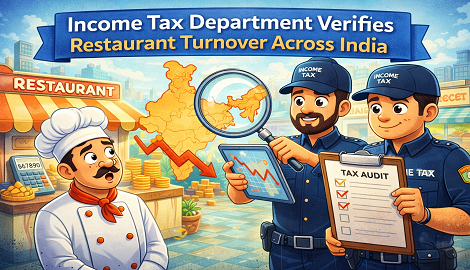
The Income Tax Department has recently carried out a nationwide verification exercise focusing on restaurants that may have suppressed their actual turnover. This action comes after an investigation c...
Selling property in India? You're probably worried about the capital gains tax bill that comes with it. Here's some good news—both the old and new tax regimes offer you ways to save big ...
Income Tax Alert - Here Are 5 High-Value Transactions That May Come Under Scrutiny. Large Cash Deposits: Any cash deposit exceeding Rs 10 lakh in a financial year across savings accounts draws...








Comments
krishan singh dosad
06-Apr-2012 , 12:16:12 pmVery Useful.