




Government detects Rs 45,000 crore GST evasion in FY19
 Print
PrintListen to this Article
0:00
0:00
Gross GST collections stood at Rs 1.02 lakh crore in July, marginally up from the previous month, but now reports have surfaced saying that government has detected Goods and Services Tax (GST) evasion of over Rs 45,000 crore during the financial year 2018-19.
According to DNA, out of which, tax sleuths have recovered an amount of Rs 25,000 crore during this period, as per the data available with the finance ministry. The revenue department of the ministry has registered around 37,000 cases in the last fiscal. The cases registered by the tax authorities range from misuse of Input Tax Credit (ITC), mis-declaration to non-filing of GST returns. The most common modus operandi of evasion is the use of fake invoices.
Arun Kumar, former professor of Economics at Jawaharlal Nehru University told the leading daily, “What one can say about gold smuggling is that 3-10% of the smuggled amount of gold gets detected. Similarly, only a small percentage of GST gets detected. But it is difficult to say the same for GST unless there is a proper study.”
It is difficult to detect tax evasion given the complexity of GST. “The complex system lends itself to tax evasion. Many items are exempt from taxes which breaks the chain. For example, wheat is exempt, atta (flour) is not. You can evade taxes on the amount of wheat you are buying and therefore not pay on the atta you sell by under-invoicing. There are many other items like these that are tax-exempt. This enables the generation of fake invoices. Tax leakage takes place further when people on the basis of fake bills claim fake credit through ITC,” he told the DNA.
Earlier reports had surfaced saying that government is working on a set of measures to remove friction points in the economy with a view to ensuring easy availability of funds to productive sectors and stimulate overall growth. However, the strategy being worked out does not include proposal for reduction of GST rates as the government believes that taxes are already lower than in the past.
Despite being an election period, Goods and Services Tax (GST) collection jumped 9 per cent in the first quarter while direct taxes rose by 12.9 per cent, close to the growth in the same period last fiscal. Corporate tax collection has also remained stable during the quarter, with a growth rate of 13.3 per cent. As far as GST revenue collection is concerned, the average mop-up has been over Rs 1 lakh crore during the quarter despite slowdown in industrial activities. GST collection soared to Rs 1.13 lakh crore in the month of April, the highest ever since the indirect tax regime was rolled out on July 1, 2017. Gross GST collections stood at Rs 1.02 lakh crore in July, marginally up from the previous month. The July 2019 mop-up was, however, 5.8 per cent higher than the Rs 96,483 crore collected in the same month last year. #casansaar (Source - DNA)
According to DNA, out of which, tax sleuths have recovered an amount of Rs 25,000 crore during this period, as per the data available with the finance ministry. The revenue department of the ministry has registered around 37,000 cases in the last fiscal. The cases registered by the tax authorities range from misuse of Input Tax Credit (ITC), mis-declaration to non-filing of GST returns. The most common modus operandi of evasion is the use of fake invoices.
Arun Kumar, former professor of Economics at Jawaharlal Nehru University told the leading daily, “What one can say about gold smuggling is that 3-10% of the smuggled amount of gold gets detected. Similarly, only a small percentage of GST gets detected. But it is difficult to say the same for GST unless there is a proper study.”
It is difficult to detect tax evasion given the complexity of GST. “The complex system lends itself to tax evasion. Many items are exempt from taxes which breaks the chain. For example, wheat is exempt, atta (flour) is not. You can evade taxes on the amount of wheat you are buying and therefore not pay on the atta you sell by under-invoicing. There are many other items like these that are tax-exempt. This enables the generation of fake invoices. Tax leakage takes place further when people on the basis of fake bills claim fake credit through ITC,” he told the DNA.
Earlier reports had surfaced saying that government is working on a set of measures to remove friction points in the economy with a view to ensuring easy availability of funds to productive sectors and stimulate overall growth. However, the strategy being worked out does not include proposal for reduction of GST rates as the government believes that taxes are already lower than in the past.
Despite being an election period, Goods and Services Tax (GST) collection jumped 9 per cent in the first quarter while direct taxes rose by 12.9 per cent, close to the growth in the same period last fiscal. Corporate tax collection has also remained stable during the quarter, with a growth rate of 13.3 per cent. As far as GST revenue collection is concerned, the average mop-up has been over Rs 1 lakh crore during the quarter despite slowdown in industrial activities. GST collection soared to Rs 1.13 lakh crore in the month of April, the highest ever since the indirect tax regime was rolled out on July 1, 2017. Gross GST collections stood at Rs 1.02 lakh crore in July, marginally up from the previous month. The July 2019 mop-up was, however, 5.8 per cent higher than the Rs 96,483 crore collected in the same month last year. #casansaar (Source - DNA)
Category : GST | Comments : 0 | Hits : 652
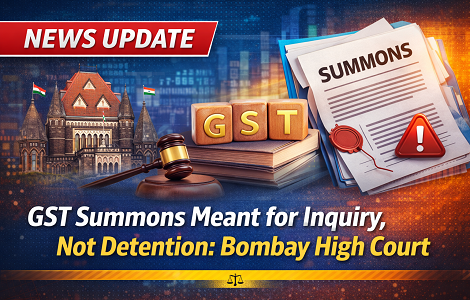
In a significant judgment, the Bombay High Court has clarified that summons issued under the Central Goods and Services Tax (CGST) Act are meant strictly for inquiry and recording of statements, and c...
Please click on the link below to view the gross and net GST revenue collections for the month of Jan, 2026. https://tutorial.gst.gov.in/downloads/news/final_approved_monthly_gst_data_for_pub...
Jan 23rd, 2026 An advisory on reporting of taxable value and tax liability under RSP-based valuation in e-Invoice, e-Way Bill and GSTR-1 / GSTR-1A / IFF has been issued for the information ...









Comments