




No revised returns permitted under Proposed GST
 Print
PrintListen to this Article
0:00
0:00
The proposed Goods and Service Tax (GST) mechanism will not permit any revision of GST returns, which may create some challenges for taxpayers. Currently, both service tax and value added tax (VAT) laws permit revision of the tax returns that have been filed. In other words, taxpayers can file a fresh return to correct any mistakes that have been made in a previous return submitted by them.
The report covering the topic "GST returns", recently released by the joint committee on business processes for the proposed GST legislation, calls for filing of returns by all registered taxpayers even if there has been no business activity during the period covered by the return. Such taxpayers will have to file a 'nil' return. GST returns will be allowed to be uploaded in the system, even in case of short payment of tax, for the limited purpose of having the information about self-assessed tax liability on record. However, from the taxpayer's perspective, such returns will be regarded as 'invalid' returns.
Bipin Sapra, indirect tax partner at EY, says, "As a return cannot be revised, it means that the taxpayers would need to have an extremely robust mechanism to record correctly the details of invoices, revenue, input invoices and other data in the original return itself. Taxpayers will have to strengthen their compliance and reporting processes and controls."
While the report does away with revised returns, it proposes that all under-reported invoices (sales) and input tax credit revisions will have to be corrected using credit or debit adjustments in the GST return for the subsequent period. Interest, if any, which is payable by the taxpayer, will be auto computed by the system.
Malini Mallikarjun, indirect tax partner at BMR Associates, adds, "The report mentions that adjustment of lower tax payments are to be corrected in the subsequent periods. Effectively, the need for return revision in this scenario is negated. Further, excess tax payment in a given period was said to be adjustable against taxes payable in a subsequent period, as per the earlier GST reports. So this provision on return revision may not be as impactful as it sounds. However, some of the details around how the adjustments get reflected in subsequent period and the efficacy of the technological platform for the same still needs to be ascertained."
The return filing formalities are proposed to be increased, both in terms of periodicity and number of forms. "For example, a service taxpayer, covered by the Central service tax legislation, is currently required to file only a half yearly return.For service taxpayers, the burden will increase manifold -in terms of periodicity of returns, number of return formats, multiplicity of compliances for separate registrations and levels of details that are required to be filled in," explains Sapra. "As per the proposal, different forms will have to be filed on a monthly basis -forms have to be filed for details of outward supplies, inward supplies and a monthly consolidated form. In addition, an annual return will also need to be filed," he adds.
Mallikarjun says, "While the current regime requires only bi-annual return for service tax, and mostly quarterly or yearly returns for VAT, the GST report seems to require companies to file three returns every month in every state that they operate in. Over and above this, there are returns for distributing credit across locations and also annual returns. Clearly, this is onerous and needs a rethink." (Times of India)
The report covering the topic "GST returns", recently released by the joint committee on business processes for the proposed GST legislation, calls for filing of returns by all registered taxpayers even if there has been no business activity during the period covered by the return. Such taxpayers will have to file a 'nil' return. GST returns will be allowed to be uploaded in the system, even in case of short payment of tax, for the limited purpose of having the information about self-assessed tax liability on record. However, from the taxpayer's perspective, such returns will be regarded as 'invalid' returns.
Bipin Sapra, indirect tax partner at EY, says, "As a return cannot be revised, it means that the taxpayers would need to have an extremely robust mechanism to record correctly the details of invoices, revenue, input invoices and other data in the original return itself. Taxpayers will have to strengthen their compliance and reporting processes and controls."
While the report does away with revised returns, it proposes that all under-reported invoices (sales) and input tax credit revisions will have to be corrected using credit or debit adjustments in the GST return for the subsequent period. Interest, if any, which is payable by the taxpayer, will be auto computed by the system.
Malini Mallikarjun, indirect tax partner at BMR Associates, adds, "The report mentions that adjustment of lower tax payments are to be corrected in the subsequent periods. Effectively, the need for return revision in this scenario is negated. Further, excess tax payment in a given period was said to be adjustable against taxes payable in a subsequent period, as per the earlier GST reports. So this provision on return revision may not be as impactful as it sounds. However, some of the details around how the adjustments get reflected in subsequent period and the efficacy of the technological platform for the same still needs to be ascertained."
The return filing formalities are proposed to be increased, both in terms of periodicity and number of forms. "For example, a service taxpayer, covered by the Central service tax legislation, is currently required to file only a half yearly return.For service taxpayers, the burden will increase manifold -in terms of periodicity of returns, number of return formats, multiplicity of compliances for separate registrations and levels of details that are required to be filled in," explains Sapra. "As per the proposal, different forms will have to be filed on a monthly basis -forms have to be filed for details of outward supplies, inward supplies and a monthly consolidated form. In addition, an annual return will also need to be filed," he adds.
Mallikarjun says, "While the current regime requires only bi-annual return for service tax, and mostly quarterly or yearly returns for VAT, the GST report seems to require companies to file three returns every month in every state that they operate in. Over and above this, there are returns for distributing credit across locations and also annual returns. Clearly, this is onerous and needs a rethink." (Times of India)
Category : GST | Comments : 0 | Hits : 896
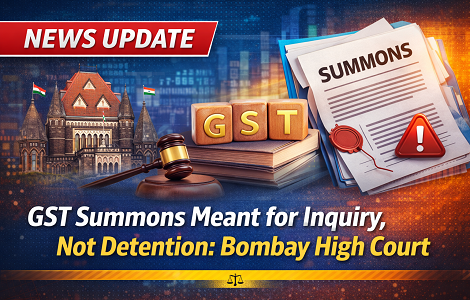
In a significant judgment, the Bombay High Court has clarified that summons issued under the Central Goods and Services Tax (CGST) Act are meant strictly for inquiry and recording of statements, and c...
Please click on the link below to view the gross and net GST revenue collections for the month of Jan, 2026. https://tutorial.gst.gov.in/downloads/news/final_approved_monthly_gst_data_for_pub...
Jan 23rd, 2026 An advisory on reporting of taxable value and tax liability under RSP-based valuation in e-Invoice, e-Way Bill and GSTR-1 / GSTR-1A / IFF has been issued for the information ...









Comments