





India Features in World Bank’s Top Five Rankings for Private Investment in Infrastructure
 Print
Print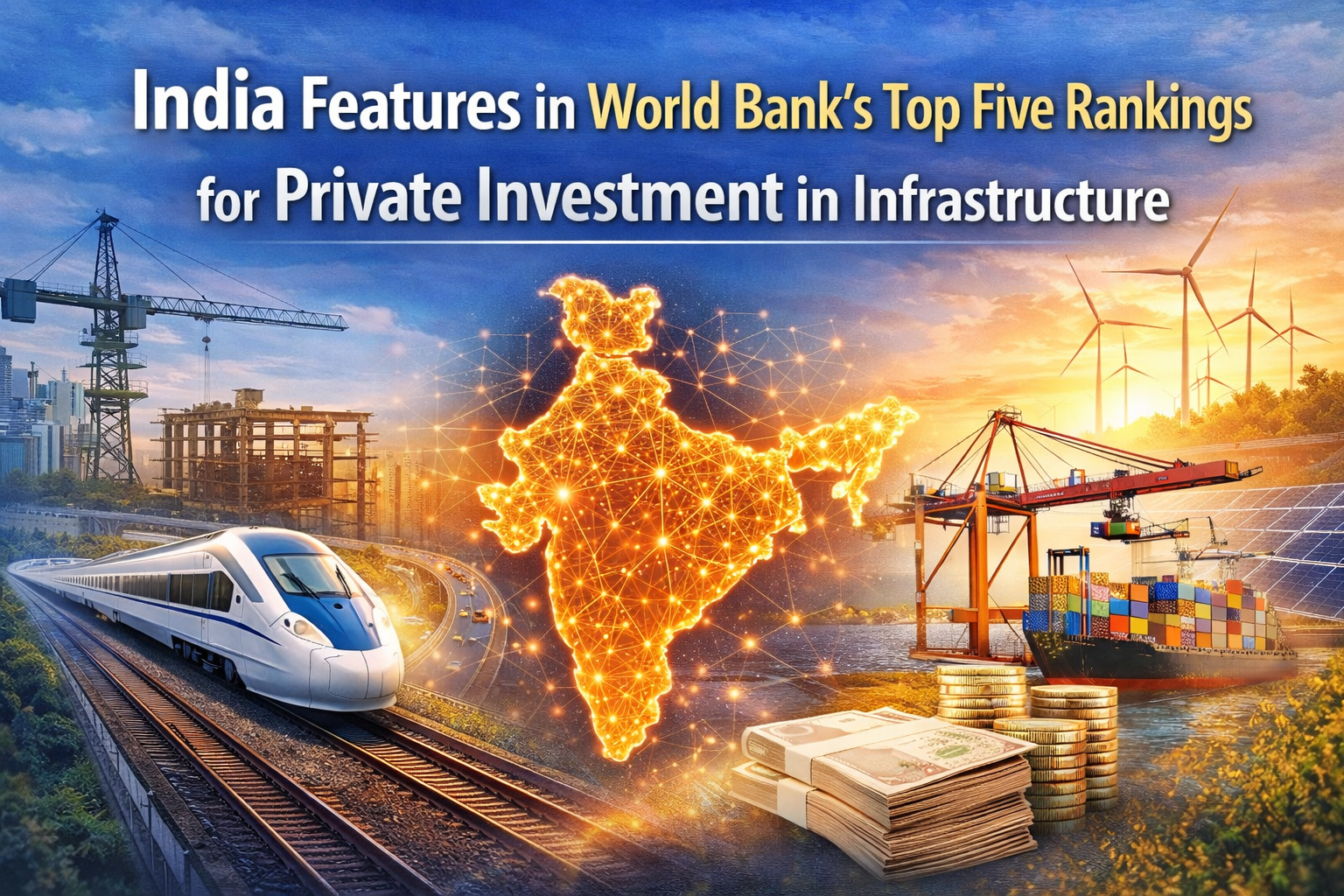
Listen to this Article
Infrastructure remains a cornerstone of India’s long-term growth framework, with public capital expenditure maintaining a consistent upward momentum since FY15. A defining development in this evolution has been the institutionalisation of integrated, multimodal planning under PM GatiShakti, supported by the National Logistics Policy and a suite of digital platforms aimed at lowering transaction costs and mitigating execution risks. These observations were highlighted in the Economic Survey 2025–26, presented in Parliament by the Union Minister for Finance and Corporate Affairs, Smt. Nirmala Sitharaman.
Sharp Acceleration in Public Capital Spending
A key driver of this transformation has been the significant scaling-up of public capital expenditure. The Government of India’s capital outlay has expanded nearly 4.2 times, rising from ₹2.63 lakh crore in FY18 to ₹11.21 lakh crore in FY26 (BE). Effective capital expenditure for FY26 (BE) stands even higher at ₹15.48 lakh crore, underscoring infrastructure’s central role as a growth enabler, particularly in view of its strong multiplier effects on economic activity, as noted in the Economic Survey 2025–26.
Evolving Infrastructure Financing Ecosystem
India’s infrastructure financing architecture is witnessing a notable transition, with funding sources increasingly diversifying beyond traditional bank lending. NBFC credit to the commercial sector recorded a robust CAGR of 43.3 per cent during FY20–FY25, while Infrastructure Investment Trusts (InvITs) and Real Estate Investment Trusts (REITs) have gained prominence as vehicles for mobilising long-term institutional capital, reflecting a maturing financing ecosystem, according to the Survey.
Strengthening Public–Private Partnerships
The Economic Survey 2025–26 highlights that the World Bank has placed India among the top five countries globally for private investment in infrastructure among low- and middle-income economies. India also emerged as the largest recipient of private participation in infrastructure (PPI) investment in South Asia, accounting for over 90 per cent of regional inflows. This global recognition is mirrored domestically in the sharp rise in project clearances by the Public-Private Partnership Appraisal Committee (PPPAC).
Expansion of Core Physical Infrastructure
National Highways:
India’s road infrastructure has expanded considerably, with the National Highway network growing by nearly 60 per cent, from 91,287 km in FY14 to 1,46,572 km by December FY26. Operational high-speed corridors have increased almost ten-fold, from 550 km to 5,364 km over the same period. Key initiatives in the road sector include high-speed corridor development, enhanced economic node connectivity, and urban decongestion, supported by a newly finalised policy for access-controlled ring roads and bypasses in cities with populations exceeding one lakh.
Railway Infrastructure:
Railway infrastructure has continued its steady expansion, with the network reaching 69,439 route kilometres as of March 2025, alongside a targeted addition of 3,500 km in FY26. Electrification has reached 99.1 per cent by October 2025. Recent years have witnessed record capital investment in the sector, prioritising new lines, network doubling, multi-tracking, rolling stock augmentation, and safety upgrades. Flagship initiatives include Economic Railway Corridors, Dedicated Freight Corridors, the Mumbai–Ahmedabad High-Speed Rail, Amrit Bharat Station Redevelopment, Kavach train protection systems, extensive track upgrades, and enhanced PPP participation.
Civil Aviation:
India has consolidated its position as the third-largest domestic aviation market globally, with the number of airports increasing from 74 in 2014 to 164 in 2025. Passenger traffic at Indian airports stood at 412 million in FY25 and is projected to rise to 665 million by FY31. Air cargo volumes also expanded from 2.53 MMT in FY15 to 3.72 MMT in FY25. This growth has been driven by policy initiatives such as RCS–UDAN, the Greenfield Airports Policy, airport modernisation, digital innovations like Digi Yatra, liberalised drone regulations, and legislative reforms including the Bharatiya Vayuyan Vidheyak, 2024 and the Protection of Interests in Aircraft Objects Act, 2025.
Ports, Shipping and Inland Waterways:
Under the Maritime India Vision 2030 and Maritime Amrit Kaal Vision 2047, India has made substantial progress in modernising port infrastructure, strengthening regulatory frameworks, enhancing operational efficiency, and expanding private sector participation. As a result, Indian ports have achieved near-global benchmarks in vessel turnaround times, with seven ports ranked among the top 100 globally in the World Bank’s Container Port Performance Index 2024. Legislative reforms in the sector include the Merchant Shipping Act 2025, Coastal Shipping Act 2025, Indian Ports Act 2025, Bills of Lading Act 2025, and the Carriage of Goods by Sea Act 2025.
Inland Water Transport has also seen rapid advancement. As of November 2025, 32 National Waterways spanning 5,155 km are operational, with cargo movement across 29 waterways, cruise services on 15, and passenger services on 23, reflecting growing multimodal integration. Cargo traffic through inland waterways surged from 18 MMT in 2013–14 to 146 MMT in 2024–25. Additionally, a ₹69,725 crore shipbuilding package approved in September 2025 aims to revitalise India’s maritime ecosystem through a four-pillar strategy focused on competitiveness, technology, and sustainability.
Energy Sector Transformation
Power Sector:
Installed power generation capacity expanded by 11.6 per cent year-on-year, reaching 509.74 GW as of November 2025. Investments of approximately ₹1.85 lakh crore under schemes such as DDUGJY, IPDS, and PM SAUBHAGYA strengthened distribution infrastructure, leading to universal village electrification and household access. Consequently, the demand–supply gap declined from 4.2 per cent in FY14 to zero by November 2025. Reforms under the Revamped Distribution Sector Scheme (RDSS) contributed to a historic turnaround, with DISCOMs recording a positive PAT of ₹2,701 crore in FY25, alongside a sharp reduction in AT&C losses. Further reforms are proposed under the Electricity (Amendment) Bill, 2026.
Renewable Energy:
India’s energy mix is undergoing a structural shift, with renewable sources accounting for nearly 49.83 per cent of total installed capacity as of November 2025. India ranks third globally in overall renewable energy and solar capacity, and fourth in wind capacity. Renewable capacity has more than tripled over the past decade, increasing from 76.38 GW in March 2014 to 253.96 GW by November 2025.
Conclusion
The Economic Survey concludes that India’s infrastructure strategy reflects a decisive pivot towards scale, integration, and quality, with sustained public investment acting as a powerful catalyst for economic growth. Coordinated development across transport, logistics, energy, digital, and rural infrastructure has begun delivering tangible efficiency gains—shorter travel times, faster freight movement, improved logistics performance, and broader access to essential services. The institutionalisation of integrated planning through PM GatiShakti, along with reforms in financing, asset monetisation, and public–private partnerships, has strengthened project execution while crowding in private investment.
India’s high-speed road network has expanded almost ten times, growing from 550 km in FY14 to 5,364 km by December FY26.
India has emerged as the world’s third-largest domestic aviation market, with the number of operational airports rising from 74 in 2014 to 164 in 2025.
Improved turnaround efficiency has placed seven Indian ports among the top 100 globally in the World Bank’s 2024 port performance index.
India now holds the third position globally in both overall renewable energy capacity and installed solar power capacity.
Category : General | Comments : 0 | Hits : 25
India's FY26 GDP Growth Projected at 7.4%, Supported by Strong Consumption and Investment Momentum
India’s economy is projected to expand by 7.4 per cent in FY26, supported by the twin drivers of consumption and investment, reinforcing its position as the world’s fastest-growing major e...
Retirement fund body EPFO has said it will no longer use Aadhaar as a valid document for proof of date of birth. In an official circular on January 16, the Employees' Provident Fund Org...
A five-day-long Special Parliament Session will be held from Monday. A Parliamentary Bulletin said, that on the first day a discussion on the Parliamentary Journey of 75 years starting from Samvidhan ...





Comments