



Budget 2026-27 Emphasises Sustainable Growth, Strengthening Capabilities and Inclusive Progress
 Print
Print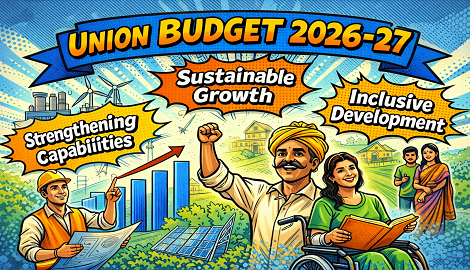
Listen to this Article
Union Minister for Finance and Corporate Affairs, Smt. Nirmala Sitharaman, while presenting the Union Budget for 2026–27 in Parliament on Tuesday, outlined three key Kartavyas aimed at accelerating reform momentum and advancing the vision of Viksit Bharat. She explained that the first Kartavya focuses on accelerating and sustaining economic growth by improving productivity, strengthening competitiveness, and enhancing the economy’s resilience amid an increasingly uncertain global environment. The second Kartavya seeks to fulfil the aspirations of citizens by building their capabilities and enabling them to become active contributors to India’s growth journey. The third Kartavya, rooted in the guiding principle of Sabka Sath, Sabka Vikas, aims to ensure that every family, community, region and sector gains equitable access to resources, infrastructure and opportunities for meaningful participation in development.
The finance minister noted that successful implementation of this three-pronged strategy depends on the creation of a strong and supportive ecosystem. A sustained push for structural reforms—continuous, adaptable and forward-looking—forms the first pillar of this ecosystem. She further emphasised that a sound, resilient and well-regulated financial sector is essential to mobilise savings, channel capital efficiently and manage economic risks. In addition, the adoption of advanced and emerging technologies, including artificial intelligence, can act as powerful enablers for improving governance, efficiency and service delivery.
Smt. Sitharaman also highlighted that the Budget, prepared for the first time at Kartavya Bhawan, carries a distinctive Yuva Shakti imprint. The proposals draw inspiration from innovative ideas shared with the Hon’ble Prime Minister during the Viksit Bharat Young Leaders Dialogue 2026, reflecting the aspirations and perspectives of India’s youth.
Reflecting on India’s economic journey over the past 12 years, the Finance Minister observed that the country has demonstrated stability, fiscal discipline, sustained growth and relatively moderate inflation. She stated that the Government has consistently pursued far-reaching structural reforms while maintaining fiscal prudence and monetary stability, alongside a strong emphasis on public investment. With Atmanirbharta at the core of its strategy, the Government has strengthened domestic manufacturing, enhanced energy security and reduced dependence on critical imports. At the same time, it has prioritised citizen-centric development and undertaken reforms to support job creation, boost agricultural productivity, increase household purchasing power and expand access to universal services. These efforts, she said, have helped sustain growth at around 7 per cent, significantly reduced poverty and improved overall living standards.
Addressing global challenges, Smt. Sitharaman pointed out that the international environment is marked by weakening multilateralism, trade disruptions and constrained access to resources and supply chains. She noted that rapid technological change is transforming production systems while intensifying pressure on water, energy and critical minerals. Against this backdrop, India will continue to move confidently towards Viksit Bharat by balancing ambition with inclusion. She stressed the importance of remaining deeply integrated with global markets by expanding exports and attracting stable, long-term investment. The Finance Minister also expressed gratitude to citizens for their continued support and partnership in India’s journey towards becoming one of the world’s largest economies.
Highlighting the Government’s objective of converting aspirations into outcomes and potential into performance, the Finance Minister reiterated its commitment to ensuring that the benefits of growth reach all sections of society, including farmers, Scheduled Castes, Scheduled Tribes, nomadic communities, youth, the poor and women.
Smt. Sitharaman further stated that the Government has undertaken comprehensive economic reforms to generate employment, enhance productivity and accelerate growth. Following the Prime Minister’s announcement on Independence Day in 2025, more than 350 reforms have been implemented, covering areas such as GST simplification, notification of Labour Codes and rationalisation of mandatory Quality Control Orders. High-level committees have been constituted, and parallel efforts are underway with State Governments to advance deregulation and reduce compliance burdens. She remarked that this ongoing “Reform Express” remains firmly on track and will continue at pace to fulfil the outlined Kartavyas.
Under the first Kartavya of accelerating and sustaining economic growth, the Finance Minister proposed targeted interventions across six priority areas: scaling up manufacturing in seven strategic and frontier sectors; revitalising traditional industrial segments; nurturing “Champion MSMEs”; providing a major impetus to infrastructure development; ensuring long-term energy security and stability; and developing City Economic Regions as new engines of growth.
Turning to the second Kartavya of fulfilling aspirations and building capacity, Smt. Sitharaman highlighted that nearly 25 crore people have emerged from multidimensional poverty over the past decade due to sustained reform-driven efforts. She announced a renewed focus on the services sector as a key pathway for meeting the aspirations of a young and dynamic population. As part of this effort, the Government will establish a high-powered Education to Employment and Enterprise Standing Committee to recommend measures that position services as a core driver of Viksit Bharat. The committee will identify priority areas for growth, employment and exports, evaluate the impact of emerging technologies such as AI on jobs and skills, and propose suitable policy responses. These initiatives, she said, will help India emerge as a global leader in services with a targeted 10 per cent share of global services exports by 2047.
Finally, outlining the third Kartavya aligned with Sabka Sath, Sabka Vikas, the Finance Minister emphasised the need for focused and inclusive interventions. These include enhancing farmer incomes through productivity gains and entrepreneurship, with particular attention to small and marginal farmers; empowering Divyangjan through improved access to livelihoods, skills training and high-quality assistive devices; strengthening support systems for vulnerable groups by expanding access to mental health and trauma care; and accelerating development and employment opportunities in the Purvodaya States and the North-Eastern region.
Category : Budget | Comments : 0 | Hits : 6





Comments