



India's FY26 GDP Growth Projected at 7.4%, Supported by Strong Consumption and Investment Momentum
 Print
Print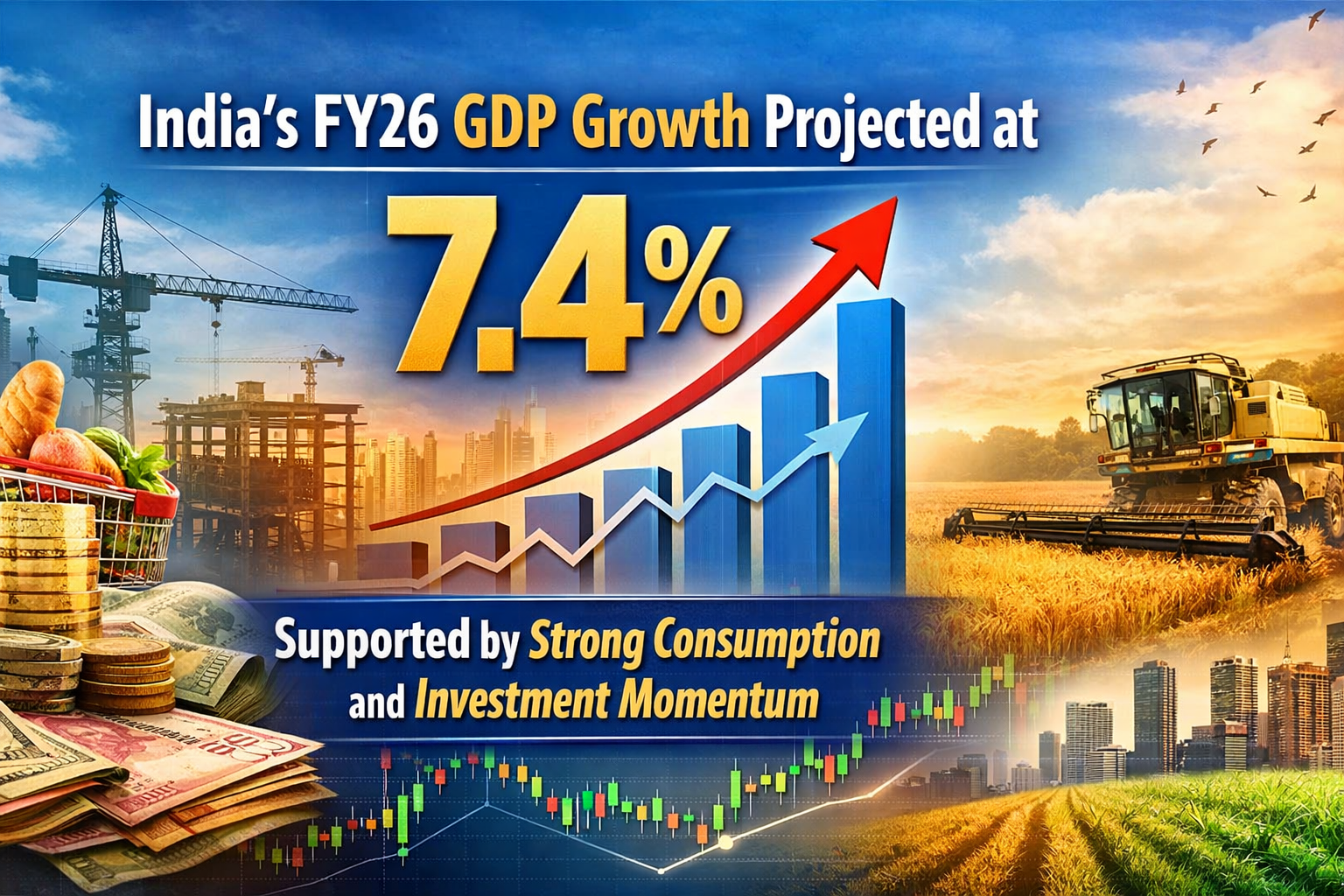
Listen to this Article
India’s economy is projected to expand by 7.4 per cent in FY26, supported by the twin drivers of consumption and investment, reinforcing its position as the world’s fastest-growing major economy for the fourth year in a row. This assessment forms a key takeaway from the Economic Survey 2025–26, presented in Parliament by the Union Minister for Finance and Corporate Affairs, Smt. Nirmala Sitharaman. Looking ahead, the Survey anticipates real GDP growth in FY27 to lie between 6.8 and 7.2 per cent, while estimating India’s medium-term potential growth at around 7 per cent, reflecting sustained structural strength in the economy.
Domestic demand continues to remain the cornerstone of economic expansion in FY26. As per the First Advance Estimates, the share of Private Final Consumption Expenditure (PFCE) in GDP increased to 61.5 per cent. The resilience in consumption is attributed to a supportive macroeconomic backdrop marked by subdued inflation, stable employment levels, and rising real incomes. Strong rural demand, aided by improved agricultural performance, along with a gradual recovery in urban consumption—supported by rationalisation of direct and indirect taxes—indicates that consumption growth remains broad-based and well distributed.
Investment has also remained a critical growth pillar during FY26. The share of Gross Fixed Capital Formation (GFCF) in GDP is estimated at 30.0 per cent, with investment activity gaining traction in the first half of the year. GFCF expanded by 7.6 per cent, exceeding growth in the corresponding period of the previous year and staying above the pre-pandemic average of 7.1 per cent, underscoring a revival in capital formation.
In the agricultural sector, agriculture and allied activities are expected to grow by 3.1 per cent in FY26. A favourable monsoon supported farm output during the first half of the year, with agricultural GVA rising by 3.6 per cent, compared to 2.7 per cent in H1 FY25, though still below the long-term average of 4.5 per cent. Allied segments such as livestock and fisheries continued to register stable growth of 5–6 per cent, increasing their share in agricultural GVA and lending greater stability to overall agricultural performance amid variability in crop output.
The industrial sector has shown renewed momentum. Manufacturing output grew by 8.4 per cent in the first half of FY26, outperforming the full-year estimate of 7.0 per cent. Construction activity also remained robust, supported by sustained public capital expenditure and continued progress in infrastructure development. Manufacturing’s share in real terms has remained steady at 17–18 per cent, while its gross value of output has stayed close to 38 per cent, comparable to the services sector. Overall, industrial growth in FY26 is projected at 6.2 per cent, higher than 5.9 per cent in FY25. High-frequency indicators such as PMI manufacturing, IIP, and e-way bill generation point to strengthening industrial demand, while steady growth in steel consumption and cement production signals resilience in construction activity. Going forward, industrial momentum is expected to remain firm, aided by GST rationalisation and favourable demand conditions.
On the supply side, services continue to be the primary engine of growth. Services GVA increased by 9.3 per cent in the first half of FY26, with full-year growth estimated at 9.1 per cent, reflecting a broad-based expansion across most segments. All major service sub-sectors have recorded growth above 9 per cent, except for the pandemic-affected trade, hospitality, transport, and communication services, which remain marginally below their pre-Covid average.
The Survey notes that demand-led growth has coincided with a sharp moderation in inflation, enhancing real purchasing power. During FY26 (April–December), inflationary pressures eased significantly, driven largely by a decline in food prices. Headline CPI inflation fell to 1.7 per cent, mainly due to lower vegetable and pulse prices, supported by favourable agricultural conditions, supply-side interventions, and base effects. While core inflation showed some persistence, this was largely influenced by spikes in precious metal prices; excluding these, underlying inflationary pressures appear considerably softer. The inflation outlook remains benign, supported by supply-side improvements and the gradual transmission of GST rate rationalisation.
Strong domestic demand and capital formation have been reinforced by a prudent fiscal policy framework. Revenue mobilisation remained resilient, with direct tax collections reaching nearly 53 per cent of the budgeted target by November 2025. Indirect taxes also performed well despite lower inflation and volatile imports, with GST collections recording multiple record highs. Tax reforms, including personal income tax restructuring and GST rationalisation, have supported consumption while maintaining revenue buoyancy. On the expenditure front, capital spending rose sharply, reaching nearly 60 per cent of the budgeted allocation by November 2025, while growth in revenue expenditure remained contained, improving the quality of public spending.
Financial markets have responded positively to fiscal discipline, reflected in lower sovereign bond yields and a narrowing spread over US bonds. Combined with a reduced repo rate, lower yields are expected to ease borrowing costs and provide an indirect fiscal stimulus. S&P Ratings upgraded India’s sovereign rating from ‘BBB-’ to ‘BBB’, citing fiscal credibility, while CareEdge Global assigned a ‘BBB+’ rating, highlighting India’s strong macroeconomic fundamentals.
Monetary policy support complemented fiscal measures through a cumulative 125 basis point reduction in the policy repo rate since February 2025, alongside liquidity infusion via CRR cuts, open market operations, and forex swaps. These actions have transmitted effectively to the banking system, with lending rates on fresh and outstanding rupee loans declining significantly.
The banking sector’s balance sheets have strengthened further, with gross NPAs falling to a multi-decade low of 2.2 per cent, stable slippage ratios, and improved profitability supported by strong net interest margins.
Despite global trade uncertainty, India’s total exports reached a record USD 825.3 billion in FY25, with continued momentum in FY26. During April–December 2025, merchandise exports grew by 2.4 per cent, while services exports rose by 6.5 per cent, offsetting a rise in the merchandise trade deficit. Remittances continued to exceed FDI inflows, helping keep the current account deficit moderate at 0.8 per cent of GDP in H1 FY26.
India’s external position remains comfortable, with forex reserves covering over 11 months of imports and nearly 94 per cent of external debt. Trade diversification efforts have gained momentum through agreements with the UK, Oman, New Zealand, and the recently concluded India–EU Free Trade Agreement, pending ratification. Ongoing negotiations with the United States are expected to further strengthen export prospects.
A major structural reform during the year was the notification of Labour Codes, consolidating 29 central laws into four codes to simplify compliance, enhance labour market flexibility, and expand social security coverage while safeguarding worker protections.
FY26 posed challenges due to heightened global trade uncertainty and tariff pressures, impacting exporters and business sentiment. The government leveraged this phase to accelerate reforms such as GST rationalisation, deregulation, and compliance simplification. FY27 is expected to be a transition year, with domestic demand and investment gradually strengthening, even as global uncertainties persist.
Globally, economic growth is expected to remain subdued over the medium term, with easing inflation and more accommodative monetary policies. Geopolitical tensions, trade fragmentation, and financial vulnerabilities continue to pose risks, though their impact on India is expected to manifest more as external uncertainty rather than immediate stress.
Against this backdrop, India’s domestic economy remains resilient. Inflation has moderated sharply, balance sheets across households, firms, and banks have improved, and public investment continues to support growth. Consumption demand remains firm, and private investment intentions are showing improvement. Collectively, these factors enhance resilience to external shocks.
The cumulative impact of structural reforms in recent years appears to have lifted India’s medium-term growth potential closer to 7 per cent. With macroeconomic stability firmly anchored and domestic drivers playing a leading role, the Economic Survey projects real GDP growth in FY27 at 6.8–7.2 per cent, signalling steady progress amid global uncertainty—calling for caution, but not pessimism.
FY27 Real GDP Growth Expected to Range Between 6.8% and 7.2%
Private Consumption Share in GDP Climbs to 61.5% in FY26
Agriculture and Allied Activities Likely to Expand by 3.1% in FY26
Industrial Activity Gains Momentum as Manufacturing Grows 8.4% in H1 FY26
Services Sector GVA Rises 9.3% During the First Half of FY26
Gross NPA Ratio Falls to a Multi-Decade Low of 2.2%
India’s Combined Merchandise and Services Exports Hit Record USD 825.3 Billion in FY25
India Finalises Free Trade Agreement with the European Union After Three Years of Talks
Category : General | Comments : 0 | Hits : 12





Comments